
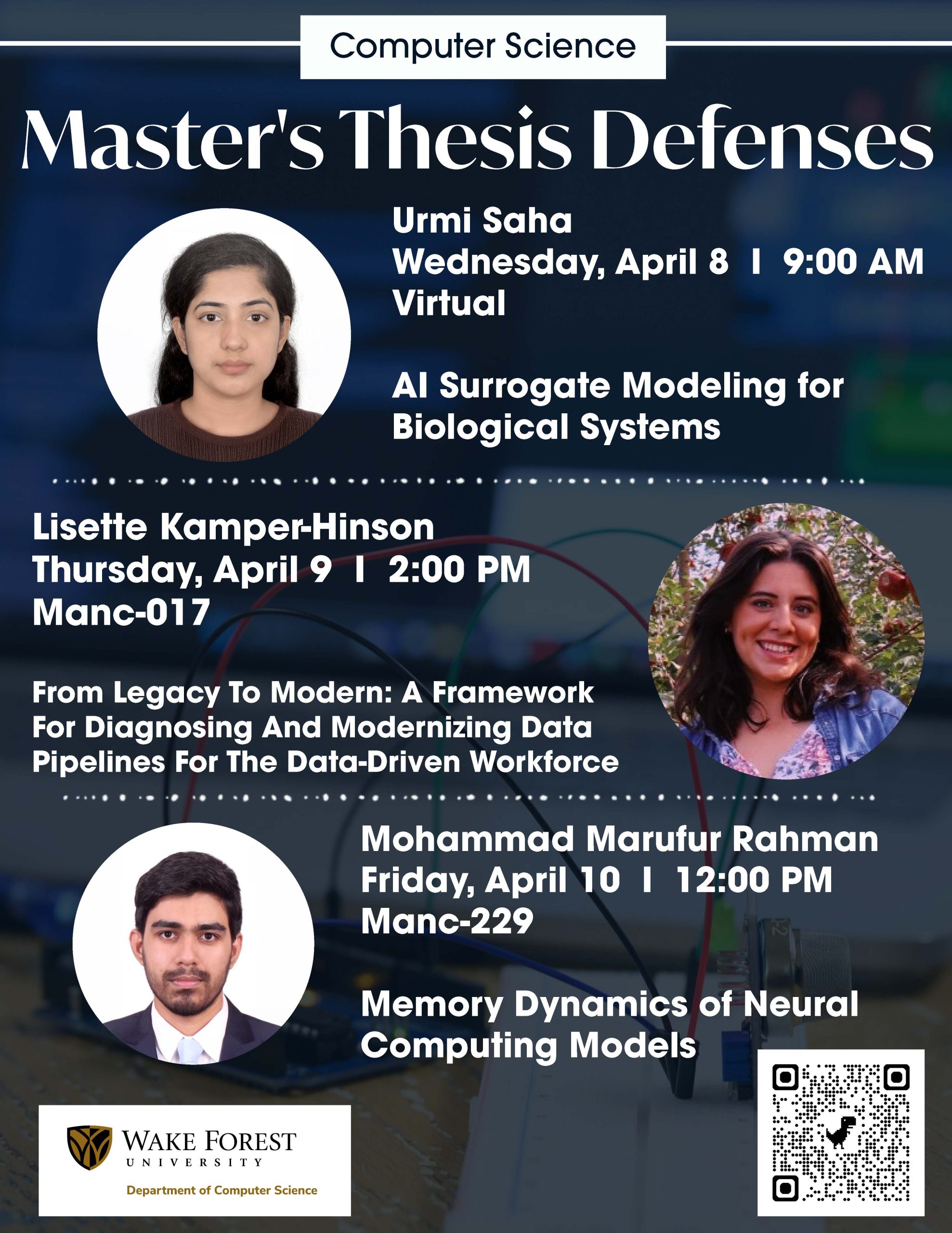
Master’s Thesis Defenses
During the week of April 6, we will have three CS MS students ready to share their findings after months of deep dives and hard work. We invite you to celebrate their hard work and academic achievements with us.
Wednesday, April 8 I 9:00 AM I Virtual
Title: AI Surrogate Modeling for Biological Systems
Abstract: Biological systems exhibit complex, nonlinear dynamics arising from molecular and cellular interactions and are commonly studied using systems biology models formulated as differential equations. These mechanistic models provide a principled framework for understanding biological processes. However, their simulation, parameterization, and refinement become computationally prohibitive and labor-intensive as model complexity and dimensionality increase. As a result, systematic exploration of biological dynamics and mechanistic hypotheses across parameter regimes, perturbations, and conditions remains a major bottleneck in basic biomedical research. We solved the simulation problem by introducing a Neural Operator surrogate for tau protein dynamics in the brain connectome that can accurately simulate complex (PDE-based) dynamics in seconds and also being computationally efficient enough for large-scale analysis. We evaluated our model with six architectural paradigms and five neural operator variants, and achieved 89% improvement over the strongest baseline. However, existing neural operator methods assume access to large, densely sampled training datasets generated by expensive numerical solvers, and no principled mechanism exists for selecting which simulations to run or which trajectories to include in training, where each simulation requires solving stiff ODE or PDE systems across high-dimensional parameter spaces, making exhaustive dataset generation computationally Prohibitive. To solve this problem by efficiently sampling train samples, we developed three IntelliAgent sampling strategies- Diversity, Active, and Two-Stage Hybrid– proposing a novel diversity score function and incorporating prediction error signal and used Fourier Neural Operator as state-of art and compared performance with 60\% data reduction, using 37.5 of training data, over five baselines across four systems biology models and achieving targeted accuracy evaluated in MSE for an oscillatory system, and presented achieved target accuracy with required number of samples and computation time with a single GPU. Both of our studies provide a practically effective solution to simulate PDEs in seconds and sampling in neural operator surrogate modeling for systems biology models without requiring any governing PDE equations.
Thursday, April 9 I 2:00 PM I Manc 017
Title: From Legacy To Modern: A Framework For Diagnosing And Modernizing Data Pipelines For The Data-Driven Workforce
Abstract: Modernization of operational data pipelines frequently emphasizes analytical sophistication while neglecting structural governance, reproducibility, and decision usability. In manufacturing environments, this imbalance can exacerbate misalignment between reported and realized production capacity. This thesis presents a structured framework for modernizing legacy capacity planning pipelines while preserving embedded domain knowledge and minimizing technical debt. The framework formalizes six stages: domain alignment, structural audit, prioritized modernization, governed modeling introduction, decision-aligned visualization design, and reproducible implementation with system-level health monitoring. The approach is demonstrated through a single-plant capacity modeling case study using read-only operational data, incorporating forecasting, scenario-based capacity simulation, and outlier detection. Quantitative evaluation compares forecast alignment with realized throughput and assesses improvements in reproducibility, interpretability, and operational transparency
relative to the legacy system. Results indicate that modernization guided by explicit structural and governance constraints improves analytical reliability without increasing system fragility. The findings suggest that modernization efforts in operational analytics benefit from treating modeling, visualization, and implementation standards as integrated system design decisions rather than isolated technical upgrades.
Friday, April 10 I 12:00 PM I Manc 229
Title: Memory Dynamics of Neural Computing Models
Abstract: This thesis investigates the memory dynamics of neural computing models, with a focus on balancing learning stability and memory efficiency. First, it addresses memory stability by analyzing catastrophic forgetting in Kolmogorov-Arnold Networks (KANs) and introduces KAN-LoRA, a novel adapter architecture that enables incremental knowledge updates in large language models while minimizing interference. Second, it examines memory efficiency by establishing communication lower bounds for matrix sketching and Nyström low-rank approximation in distributed-memory environments and by proposing communication-optimal parallel algorithms. These algorithms, implemented on modern CPU and GPU supercomputing infrastructures, achieve substantial parallel scalability and significantly reduce the communication overhead in large-scale matrix computations. Building on these insights, the thesis further presents a data-aware extreme compression algorithm for large language models, preserving targeted knowledge in the compressed model and facilitating the deployment of advanced AI on resource-constrained systems. Overall, this work advances the understanding of neural memory dynamics and provides practical methods for stable, efficient, and scalable neural computation.
All are welcome!