
When RPKI Meets Reality: Understanding and Improving Internet Routing Security by Dr. Weitong Li
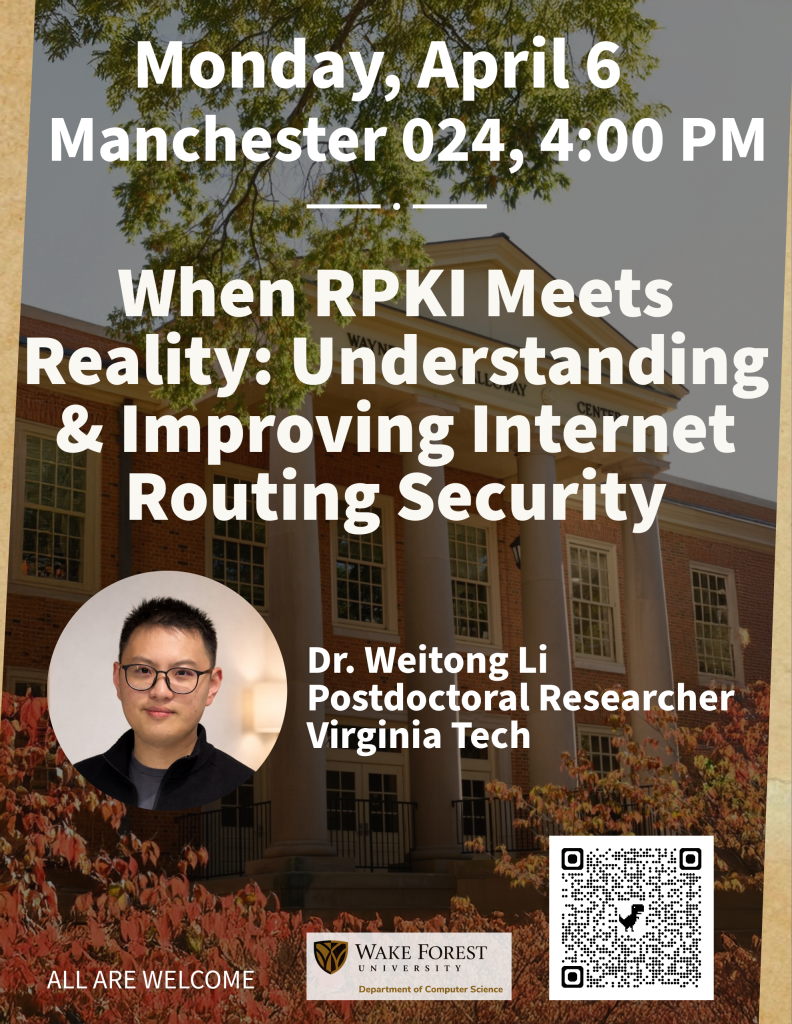
Join us Monday, April 6, at 4:00 PM in Manc 024! Dr. Weitong Li from Virginia Tech will deliver a talk titled, “When RPKI Meets Reality: Understanding and Improving Internet Routing Security“.
Abstract:
The Border Gateway Protocol (BGP) underpins global Internet connectivity but lacks built-in origin authentication, making it vulnerable to misconfigurations and hijacks. The Resource Public Key Infrastructure (RPKI) has emerged as a practical defense, yet its real-world effectiveness remains incomplete and often misunderstood.
In this talk, I will present my work on understanding and improving routing security in practice through Internet-scale measurement and system design. My work first focuses on understanding the protection and deployment ecosystem of RPKI on the Internet. From the measurement, I will discuss the remaining security and performance challenges in the routing system, and how we can improve it with new protocols and system design. To understand emerging risks in today’s operational ecosystem, my work further uncovers how now business and operation models introduce systematic misconfigurations that can enable stealthy routing attacks. Together, these results provide a new, data-driven view of how routing security actually operates on today’s Internet, highlighting both the progress made and the structural challenges that remain.
Bio:
Weitong Li is a postdoctoral researcher at Virginia Tech, where he received his Ph.D. in Computer Science advised by Taejoong (Tijay) Chung. His research focuses on measuring and securing Internet routing infrastructure. His work builds Internet-scale measurement systems and deployable security mechanisms to uncover hidden dependencies, misconfigurations, and security risks in real-world networks.
His research has appeared in top venues including IEEE S&P (Oakland), NDSS, USENIX Security, and IMC. His systems and datasets—such as RoVista, RScope, ImpROV, and ASINT—are widely used by researchers, network operators, and policymakers, and have informed discussions in operational communities and standards bodies. He is a recipient of the ISOC Pulse Fellowship and ARIN 57 fellow.
All are welcome!