
Building AI-Forward Pathways: Community Colleges and the Workforce of Tomorrow by Dr. Sarah Rodriguez
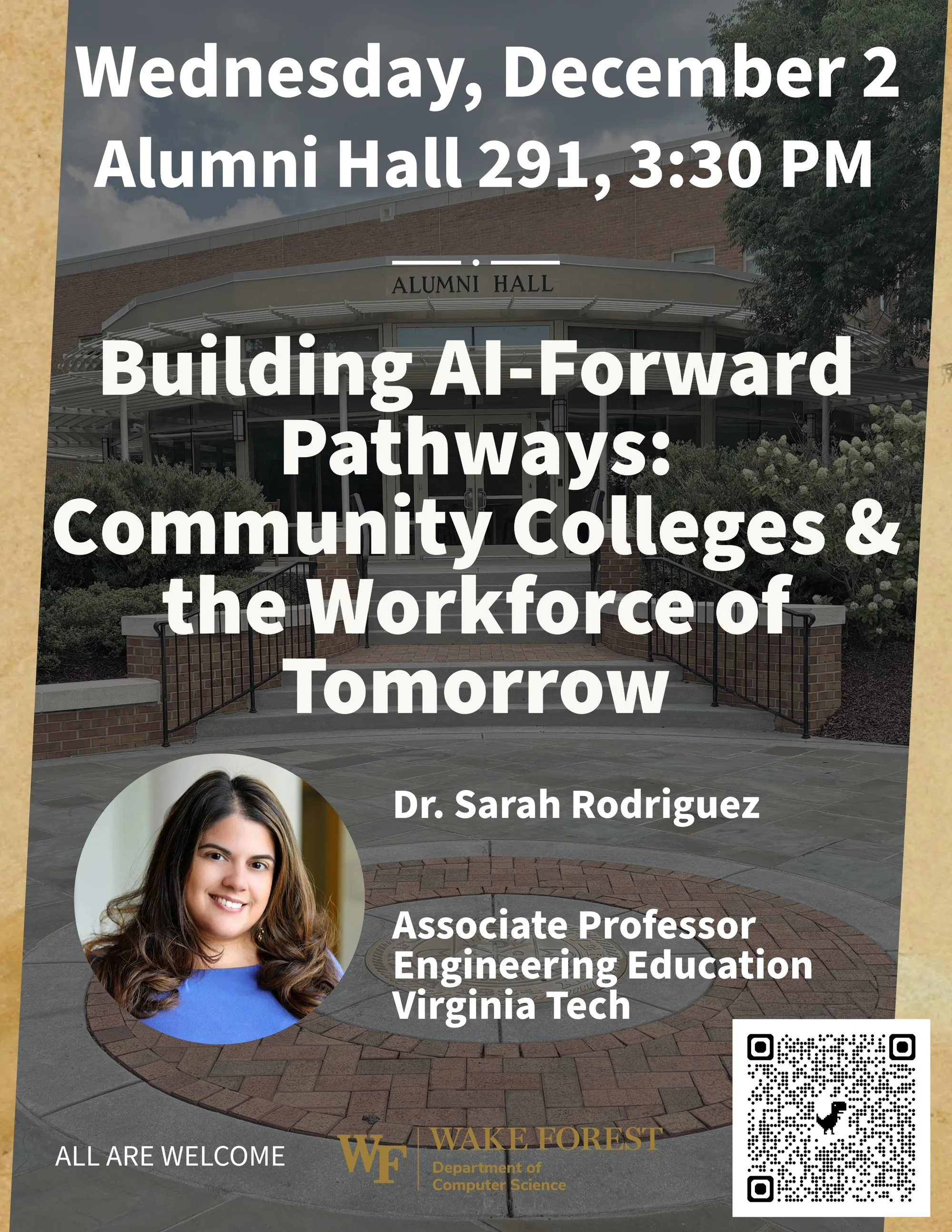
Join us Wednesday, December 2 at 3:30 PM in Alumni Hall 291! Dr. Sarah Rodriguez, Associate Professor of Engineering Education at Virginia Tech, will share with us her insights on Building AI-Forward Pathways: Community Colleges and the Workforce of Tomorrow.
Abstract
Artificial intelligence is reshaping workforce preparation, and community colleges are
at the forefront of helping students, faculty, and institutions adapt. This seminar draws on
findings from a national mixed-methods study conducted through the National Applied AI
Consortium (NAAIC) to examine how colleges are integrating AI literacy, generative AI, and
machine learning into curriculum, credentials, and teaching practices. The talk will highlight
emerging opportunities and challenges related to faculty development, institutional readiness,
and AI policy, while offering research-based insights and practical examples to support AI-
forward educational pathways.
Dr. Sarah L. Rodriguez is an Associate Professor of Engineering Education at Virginia Tech whose research focuses on broadening participation in computing, artificial intelligence (AI), and engineering education. Her work examines how educational systems, institutions, and workforce partnerships can create more equitable pathways into technology-related fields, particularly for students from historically underserved communities. Rodriguez’s research explores computing identity development, AI capacity building, transfer pathways, and workforce preparation across K-12, community college, and university contexts. She is especially interested in how students develop interest, confidence, and belonging in computing and how institutions can better support their success. Her work has highlighted the experiences of rural, Latine, transfer, and low-income students pursuing computing and engineering pathways. Committed to bridging research and practice, Rodriguez collaborates with educators, institutional leaders, policymakers, and industry partners to strengthen AI and computing ecosystems. Her scholarship, supported by organizations including the National Science Foundation, informs strategies for expanding access to emerging technologies and preparing a diverse workforce. Through her research and leadership, she advances inclusive approaches to computing and AI education that support opportunity, innovation, and societal impact.
All are welcome!